

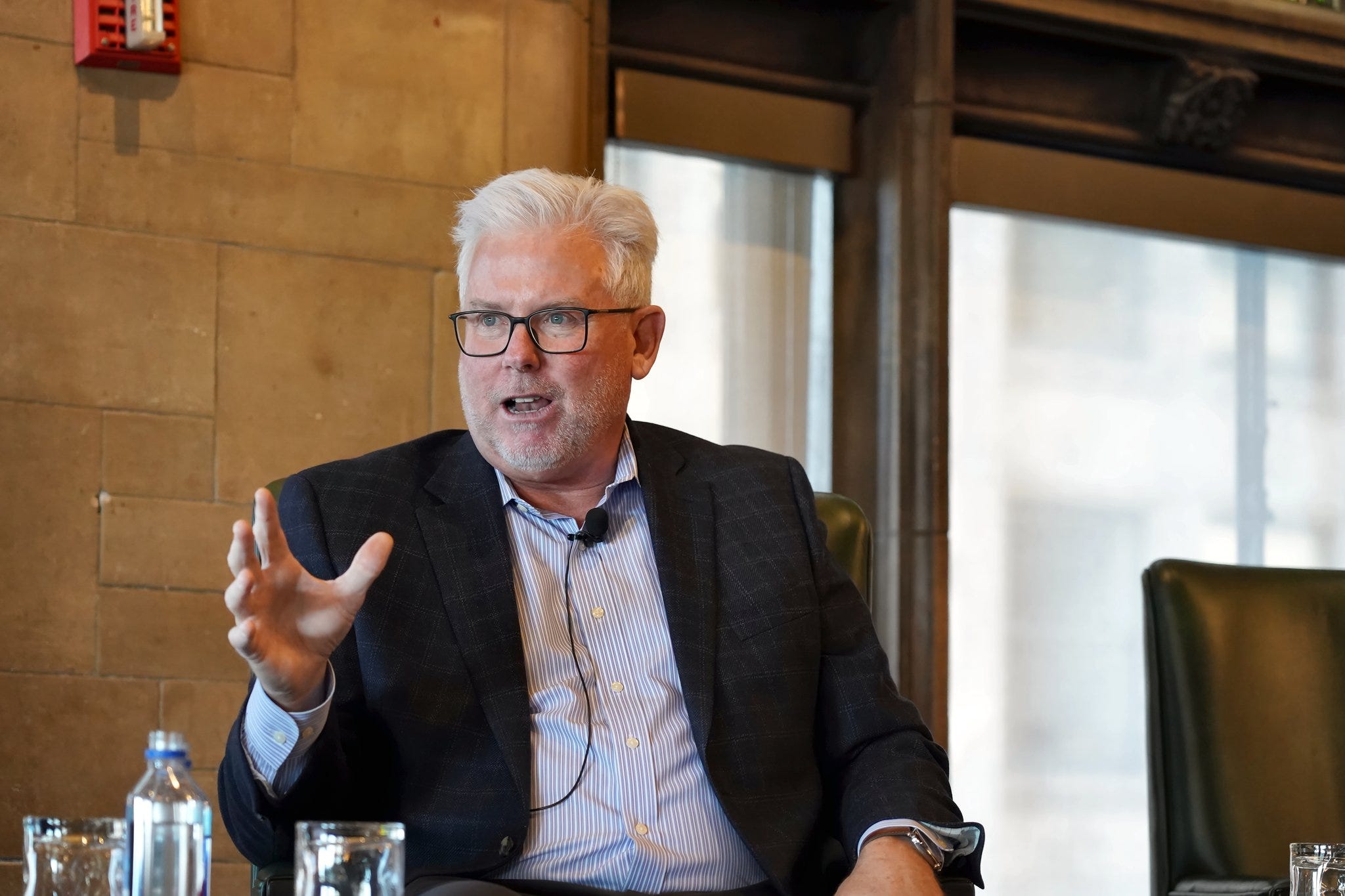
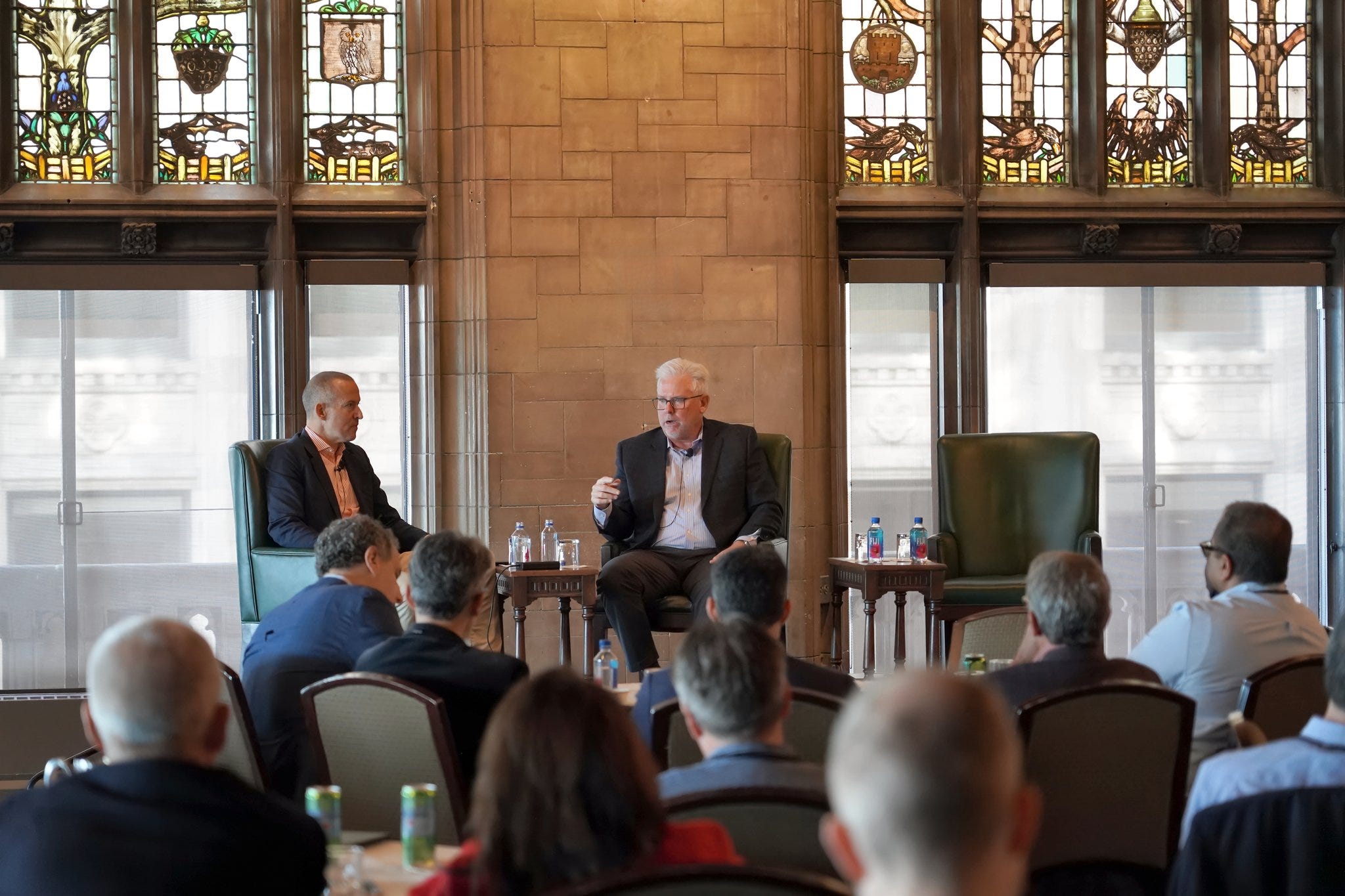
What would it take for US stocks to return 10.5% a year over the next decade? Chris Bloomstran of Semper Augustus Investments Group did the arithmetic live at Latticework 2026, on the market and on an AI spending cycle “bigger than railroads.” A year ago he called a secular peak in US stocks; by June in Zurich, the call had eased to a plateau. He still sees a plateau, with S&P 500 margins near 14%, a mid-20s multiple, and 40% or more of the market concentrated at the top: “To me, that’s where the risk is.”
Bloomstran is President and Chief Investment Officer of Semper Augustus Investments Group in St. Louis, which he co-founded in 1998. Introducing him, John Mihaljevic of MOI Global noted that every spring, serious investors read two letters on Berkshire Hathaway: Warren Buffett’s and Bloomstran’s, which tends to be longer. For the fuller story, listen to our free audio program, Chris Bloomstran: The Flawed Bulb.
The market is still on a secular plateau
Margins are at a record and the multiple is in the mid-20s, so the plateau Bloomstran described in June still holds. In 2021, the S&P 500 earned a record 13.3% margin at about 23 times earnings. In 2022 the index fell 18% as margins slipped a couple hundred basis points and the multiple dropped to 19. By the end of 2025 the margin was back near 13.3%, but the multiple had risen to 26. At the end of September it was 13.8% on about $300 of index earnings, and forward estimates imply 15.5%, a number he called crazy. Part of the lift is accounting: chip makers book their AI revenue and profit at once, while the hyperscalers depreciate the same spending over years.
Buffett’s 1999 Fortune piece called the last secular peak, Bloomstran said: margins that had ranged between 3% and 6% in his lifetime were heading for 8%, and they fell back to 5.5% in the 2000 to 2002 bear market. What nobody foresaw were the ultra-low interest rates that added three points to margins, or the capital-light businesses earning margins in the mid-20s and mid-30s. He does not expect margins to return to 4% to 6.5%, but he does expect some mean reversion, in a market where 40% or more of the value sits in the Mag Seven plus a few names such as Micron and Broadcom.
A 10.5% decade needs 45 times earnings
At today’s margin, a 10.5% annual return for the next ten years takes a 45x multiple. Bloomstran’s five-factor model splits returns into the change in the multiple, the change in margins, the dividend yield, sales growth, and the change in the share count. Hold the multiple instead, and the margin must rise to 20% to 21%; split the difference, and it is 35 times earnings on a 16.5% margin. Energy flatters today’s profits as well: refiners are earning distillate spreads that he called unsustainable.
“If you hold the margin constant with where we are today, you’ve got to take the multiple up to 45 times earnings on today’s margin.”
AI capex is a test of returns on capital, not of revenue
The AI build-out will be judged on returns on capital, and he believes those peaked two years ago. The hyperscalers spent about $400 billion last year and are set to spend about $900 billion this year; at that pace, cumulative spending reaches $5 trillion to $10 trillion. Even at a 10% depreciation rate, about 80% of it stays on balance sheets, against a book value of $12 trillion for the entire S&P 500. One bullish forecast he heard this fall had the five hyperscalers’ operating CF growing to almost $5 trillion within five years, roughly double what the whole index earns today; even then, returns on all that new, largely debt-financed equity would fall to single digits for companies that earn 32% on equity today. Bloomstran expects the spending to stop when the companies, or Wall Street, decide the returns are not there: “The greater they build it, the greater the bust that’s coming.”
“So we’re going to essentially nearly double the book value capital of the entire stock market, and we’re not going to make 20 points on capital and 30 on equity. The math just doesn’t work.”
Buybacks never shrank the share count
For 25 years, about half of operating cash flow went to buybacks, yet the share count is higher than it was. At year-end, he added, it was lower. The count ballooned in the 1990s, when companies paid insiders in stock, and buybacks are now way down as Meta, Microsoft, and Google need the cash for capital spending. He expects the share count to “rise materially as long as this capital cycle persists.”
At a secular peak, value investing takes more activity
Asked why his second-largest position is not a high-quality company, Bloomstran said buy-and-hold is a harder game at a secular peak. Even Buffett, whose ideal holding period is forever, has been active with Berkshire’s stock portfolio over the years. The classic compounders of the past 20 years have traded at 40-60x earnings, much like the Nifty Fifty before 1972, and few can still grow fast enough to earn it. His turnover has averaged 15% a year; this year it is 40%. Semper Augustus buys cyclicals, commodity chemicals, branded apparel, shoes, and dollar stores when they are out of favor. “My holding period ideally is forever,” he said, “but that’s implausible.”
Berkshire after Buffett will be judged in the next decline
Greg Abel’s real test will come in the next deep decline, not in a rising market. His first opportunity, Bloomstran said, is the operating work he led as vice chairman: the railroad, under-earning by about $2 billion a couple of years ago, has fixed much of that, GEICO has been fixed, and the manufacturing, service, and retailing businesses earn more. The harder question is cash. Of roughly $355 billion, he estimates the insurance and operating businesses need about $120 billion, leaving about $240 billion to deploy plus about $40 billion a year, and few private companies are big enough to absorb it. Buffett, he noted, acknowledged doing too little in the stock market in 2008 and 2009.
“If Greg got that message and gets it, you want to see him lean in very hard, but only when the prices make sense.”
What he expects from the stock itself, including his appraisal of the B shares and how far he has cut it on his buy list, is below the line.
Below the line
Paid members get the investable specifics from this session:
His second-largest holding: an airline, in an industry he calls a horrible business; his five-year math on revenue, margins, and market value; and his one-word answer on when he would trim it.
Two athletic-footwear companies taking share from the old giants, one of which he called “as cheap as anything in the portfolio,” and his answer to whether a shoe brand is just a fad.
A building-products company he began buying as a housing-cycle bet, and the demographic shift he says could prove him wrong.
His appraisal of Berkshire’s B shares, how far he has cut the stock on his buy list, and the return he expects for a buyer at today’s price over the next 10 to 15 years.
The refiners, dollar stores, and famous warehouse retailer he has trimmed or sold down, and why.
All 47 minutes of the session, the key segments as 15 short clips you can play on their own, and the full transcript.
Paid members hear every Latticework 2026 session in full, with transcripts.


