

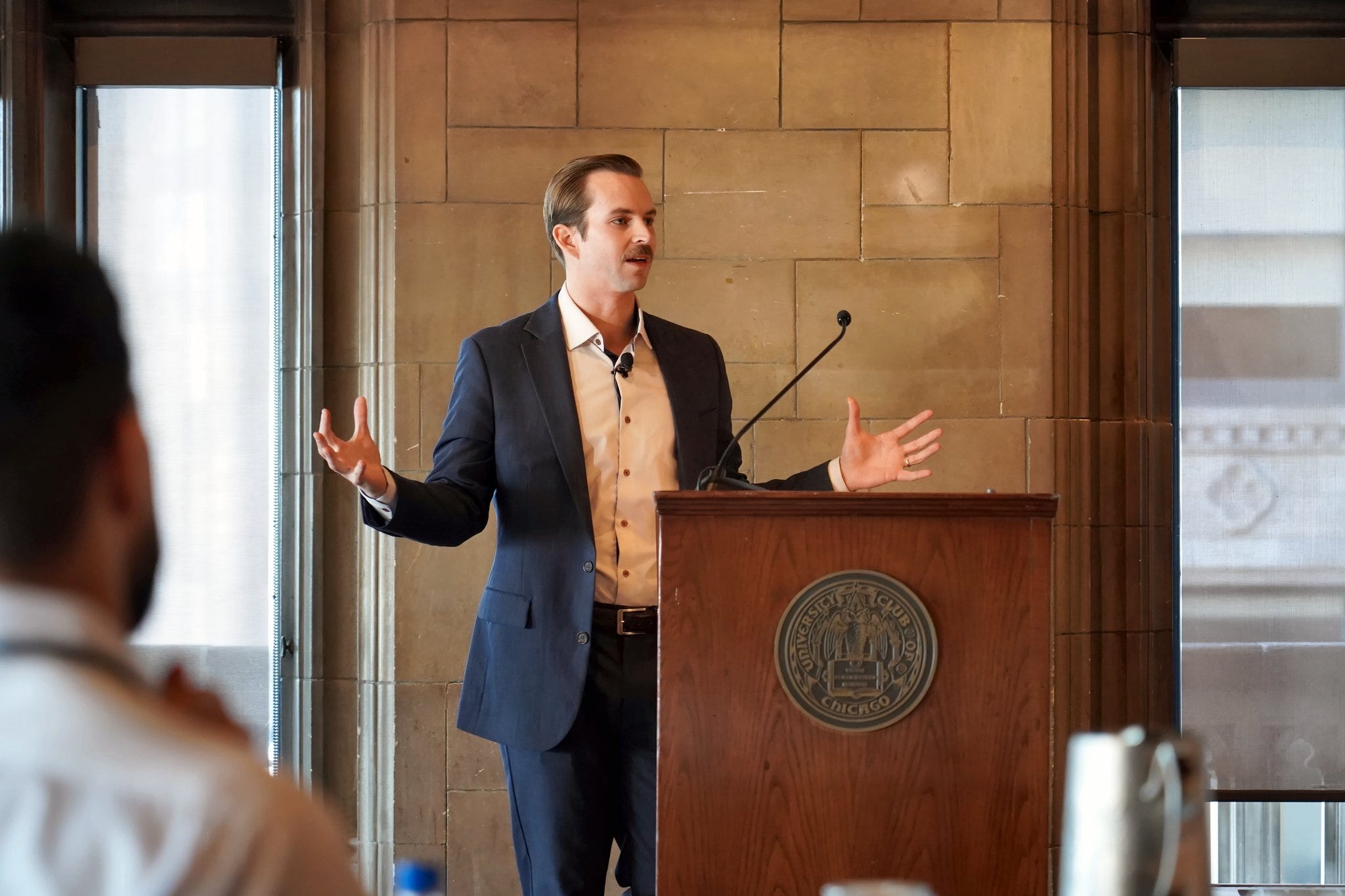
How does an investor’s thinking change when AI does more of it, and where does the edge go? That is the question Lucas Miller, a cognitive neuroscientist on the MBA faculty of UC Berkeley’s Haas School of Business, set out to answer in “The Augmented Investor” at Latticework 2026, drawing on extensive interviews with investors and decision researchers, a survey of more than 120 attendees, and a review of a couple hundred papers.
His answer was more hopeful than most, with a condition attached: “complementarity has to be earned.”

Three takeaways
The “bitter lesson” stops at long-horizon investing. In 2019, Rich Sutton observed that across 70 years of AI research, general methods that scale with computing power have beaten methods built on human expertise. Miller argued that compute wins where a goal can be specified and each attempt scored quickly, as in chess, code, and math. Investing is what psychologists call “a wicked learning environment”: feedback is slow and noisy, and by the time it arrives the game may have changed.
“My claim today is the bitter lesson will not apply to long-horizon fundamental investing.”
Edge moves to what AI cannot read. Reading 500 pages a day, as Warren Buffett advised, still builds judgment, Miller said, “but as a comparative advantage, it’s gone.” The investors he surveyed and interviewed see the lasting human edge in framing the right questions, reading management, and finding what is not written down: site visits, deep research, and talking to the person who knows a company’s culture six months before the news does.
“If it’s legible to AI, many, many, many thousands of AIs have automatically already read it. So it’s not an edge, necessarily.”
Think first, and remember that the machine has no courage. Asking AI for a draft and then reviewing it anchors you; Miller cited a new Anthropic study in which experienced analysts sided with their AI agent’s secretly assigned preference on 86% of key judgment calls. He finds AI far more useful for killing ideas than for building conviction, and conviction rests on something no model has.
“It doesn’t bear the consequences of its actions. So it has no courage. Humans have courage.”
His eight practices
Miller closed with his evolving list of practices for keeping your judgment while you use the tools:
Triage wide, then read deep. Use AI as a filter for your finite attention, not to widen the funnel.
Find what is not written down. Information that is not legible to AI is a source of edge.
Think first, then compare. Write your own view before you read the AI’s, or you anchor on its answer.
Fight your AI on specifics. A general request for skepticism returns a confident, generic bear case. Challenge one dimension at a time, and remember that “there is no substitute for authentic dissent.”
Do the reps that build judgment. Read primary reports on paper and write by hand: the mind, like the body, is use it or lose it.
Use AI as a cross-domain tutor to get to the essence of a new field or company quickly.
Barbell your thinking. Be “extremely analog and extremely augmented,” and avoid the messy middle.
Keep an owl on your shoulder. Make your process and decisions legible to AI so it can point out errors and broken promises, while you still make the decisions.
Below the line
Paid members get:
The full talk and Q&A: 43 minutes of audio, the key segments as 14 short clips, and the transcript, in the post and as a PDF.
The Q&A: how to make AI a real sparring partner rather than a yes-man or a reflexive critic, why AI synthesis “removes the tails” and how to point it back at them, and whether AI favors the specialist or generalist.
What the survey of the room found, including the share of attendees who think valuation will stay human.
From the same afternoon: the idea pitches in which fear of AI created mispricing, including a US government-software leader, a social platform down more than 60% this year, and Japan’s largest direct-recruiting platform, plus a Korean company pitched as an AI beneficiary.
Paid members hear Latticework 2026 sessions in full, with transcripts.


