

This audio program is part of the Great Investors podcast, by Latticework.
Murray Stahl grew up in Bedford-Stuyvesant, in a household that spoke Yiddish and Russian. He went to Brooklyn College and joined Bankers Trust in 1978. He stayed sixteen years, working up investment strategies off the beaten path. He and Steven Bregman left the bank in the fall of 1994 to start Horizon Asset Management. Kinetics followed in 1996 and FRMO in 2001. He wrote with a ball point pen to slow his writing. He died on April 7, 2026.
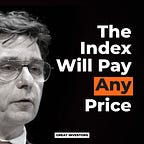
On his account, the indexes behind ETFs changed their calculation around 2006, from market cap to float, the shares in public hands. The index is price indifferent, with no price at which it stops buying. On a call in October 2016 he described what he looked for: “For us, a true alternative asset is a rare company that’s not likely to access the capital markets. Therefore, in the long run, the behavioral characteristics will be based on a certain scarcity value. That’s kind of what we’re looking for, scarcity value of a hard asset, encased in scarcity value of corporate structure.”
An owner-operator, he said in 2018, is a company whose leaders own more equity than anyone else. Dormant assets, he said in October 2015, are potentially productive but dormant at the moment. Spin-offs he compared to expelling the worst student from a class: the average grade goes up, but the average student learned no more. The opportunity was with the parent. In late 2007 he launched a fund to own securities exchanges. In 2008 he could not find a single person who agreed with him. One royalty company he worked through had more reserves in its 2021 annual report than thirty years earlier.
The program opens at the Best Ideas conference in January 2018. Near the end of that talk he said he had owned one stock since 1984 and bought more that day in his own account. It goes back to 1984, when he turned the wrong way out of a downtown elevator and read an unfamiliar name off a door. It follows the business plan he and Bregman made at a Burger King table in 1994, which put a ceiling on assets. In 2008 every investment he touched did poorly, and he did not blame his own analysis. It quotes the July 2010 letter telling shareholders he had begun designing indexes of his own. Its last section covers the quarterly call of March 3, 2026, on which he answered what he most regretted.
He spoke at MOI Global’s Best Ideas conference in January 2018 and at the Latticework summit in September 2018. At Best Ideas he said he could not run a diversified portfolio and worked through Texas Pacific Land Trust. At Latticework he named companies one at a time, with his reasons for each, and withdrew the timing call he had made in April 2016. For more, see Replay of a Fireside Chat with the Legendary Investor at Latticework 2018.
The program runs sixty-nine minutes.
Get the next program the day it comes out. Great Investors is on Apple, Spotify, and YouTube (or add the podcast feed to any app).
Transcript
The transcript is available for download to members only.


