

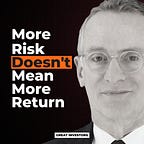
This audio program is part of the Great Investors podcast, by Latticework.
Howard Marks has spent more than half a century on a problem he says he still has not solved: what risk actually is, and what an investor can do about it. His career runs from equity research in the late 1960s, through the launch of Citibank’s convertible and high-yield bond funds in 1978, into distressed debt in 1988, and on to the firm he co-founded in 1995. Through all of it he has written memos to anyone willing to read him.
One of the recurring lessons in Howard’s work is that knowing where a market is going and knowing where it stands are entirely different problems, and only the second one is solvable. He is unusually willing to say so plainly. Asked at a Latticework summit what he was still curious about, he named the subject he is best known for: “In investing, the greatest puzzle for me is risk, how we should think about it, and how we can work with it.”
That idea runs through this audio program. It traces Howard’s early years as an analyst and the three lessons he took from them; the 1978 telephone call that sent him into a market with a bad name and no data; the first memo he ever published, in October 1990, written five years before Oaktree existed and already containing the sentence the firm would be built on; the decade he wrote without receiving virtually a single reply; the memo he published three days after Lehman failed; and the argument with his son Andrew that revised part of his own framework fifty years into his career.
We are grateful to Howard for the wisdom and insights he has shared with the MOI Global community over the years, at Latticework summits, at Best Ideas, and in conversation during the crisis of 2020. He has spoken with unusual candor about what cannot be known, about the difference between controlling risk and avoiding it, and about the discipline of daring to look wrong for as long as it takes to be proved right.
Our hope is that this special episode, Howard Marks: Higher-Level Thinking, will help more investors appreciate the depth of Howard’s approach. It is a program about risk, but also about writing, temperament, and the willingness to keep an important question open for fifty years rather than pretend it has been settled.
For those willing to think at the second level, the lesson is not that the future can be read. It is that knowing where you stand, and sizing your positions accordingly, remains one of the investor’s most durable advantages.
Get the next program the day it comes out. Great Investors is on Apple, Spotify, and YouTube (or add the podcast feed to any app).
Transcript
The transcript is available for download to members only.


