

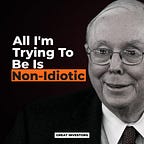
We are delighted to share with you our audio program on Charlie Munger, vice chairman of Berkshire Hathaway and chairman of Wesco Financial and the Daily Journal Corporation, part of the Great Investors podcast by Latticework. Each program in the series is an hour-long narrated profile of one investor, drawn from the investor’s own letters, talks and meetings. We make these programs so that members can learn how a great investor thinks and works, through the decisions he made and what he said about them at the time. Your feedback on what was useful, and on which investors to cover next, shapes what we produce. We start with who he is:
Charles Thomas Munger was born in Omaha, Nebraska, on January 1, 1924, the son of a lawyer. His first job was at Buffett & Son, an Omaha grocery store where Warren Buffett would later work. He graduated from Harvard Law School in 1948 and moved to Southern California. In 1962 he helped found the firm that became Munger, Tolles & Olson, and by 1965 he had left the law. He was vice chairman of Berkshire Hathaway from 1978, chairman of the Daily Journal Corporation from 1977 to 2022, and chairman of Wesco Financial from 1984. He died on November 28, 2023, at 99.
He argues that stock picking is a branch of worldly wisdom, and that worldly wisdom needs models from many disciplines. With only one or two models, he told students at the University of Southern California in April 1994, a person tortures reality until it fits them. The same lecture explained how he and Buffett moved past Benjamin Graham’s bargains: over decades, a stock can hardly earn much more than the business underneath it. In his Wesco letter for 1989 he wrote: “It is remarkable how much long-term advantage people like us have gotten by trying to be consistently not stupid, instead of trying to be very intelligent.”
The mental model he built the stock market on is the racetrack, where everybody bets and the odds move with the betting. The track takes 17 percent off the top, the market much less, so the wise bet heavily on the rare mispriced bet and the rest of the time do not. Misjudgment is his catalog of twenty-five tendencies, incentives first: FedEx got its night shift to load the planes fast enough only when it paid by the shift and let them go home once the planes were loaded. The wonderful business is See’s Candies, bought in 1972 for $25 million, about three times its net tangible assets; he and Buffett then raised its prices a little faster than others might have.
The program opens at the Daily Journal annual meeting in Los Angeles in March 2015, where close to two hours went to questions. It goes back to Omaha and the two clients of his father’s practice, Grant McFayden and Mr. X. It has the 1986 commencement address at the Harvard School, a speech on how to guarantee misery, built backward. It works through the 1994 lecture on worldly wisdom, the misjudgment talk, the Wesco letters and his 2014 account of the Berkshire system. It closes with what he told the law graduates of 2007: that, like Epictetus, he had had a favored life.
Beginning in 2018, members of MOI Global, the community behind the Best Ideas conference and the Latticework summit, gathered in Omaha on the Berkshire weekend for Best Ideas Omaha. In 2017 Phil Ordway updated the misjudgment talk with newer cases, which MOI Global published as Human Misjudgment Revisited. At Latticework 2025 in New York, Tom Russo of Gardner Russo & Quinn recalled meeting Munger at Stanford Law School. For more, see Remembering Charlie Munger: Life and Legacy, the This Week in Intelligent Investing episode MOI Global recorded two days after the news and released on December 2, 2023.
The complete program runs sixty-seven minutes.
Get the next program the day it comes out. Great Investors is on Apple, Spotify, and YouTube (or add the podcast feed to any app).
Transcript
The transcript is available for download to members only.


